Colorwood Words - Cryptogram
- 4.5
- Rating
- 1.00M
- Installs
- Free
- Price
 Analysis by App-foxy
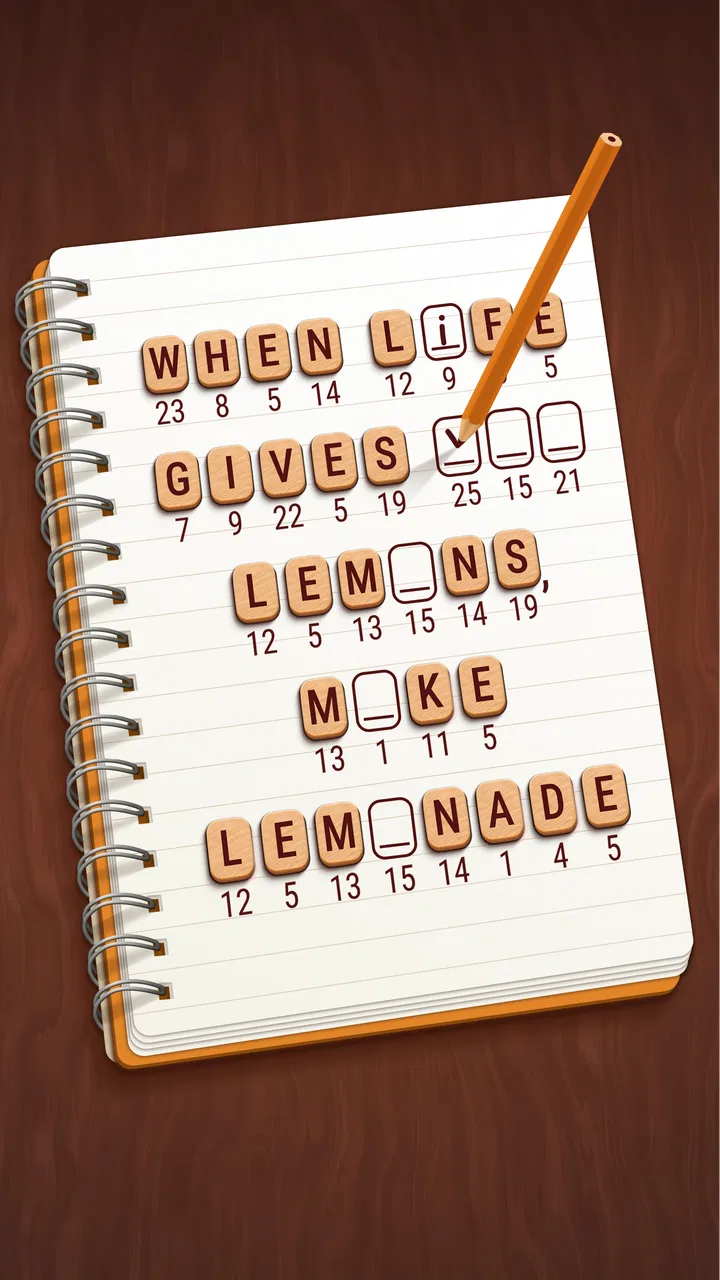
I went into Colorwood Words expecting a familiar word puzzle, but its use of letters and numbers gives the basic cryptogram idea a slightly different feel. Instead of simply searching for a word from a clue, I have to examine the relationship between symbols, test a possible reading, and use the result to uncover the hidden answer. That makes each round feel more like a small act of deduction than a standard vocabulary quiz.
It is a free word game from Burny Games, rated for Everyone, and it runs on Android from version 7.0 onward. The game has built a sizeable audience, with over a million installs and an average score of 4.5 from around ninety-nine thousand ratings. Those figures suggest that its short, repeatable puzzle format has broad appeal, but they do not remove the need to ask whether this particular style of wordplay suits you.
After spending time with it, my view is straightforward: this is best for players who like quiet reasoning in compact sessions. It is less suitable if you want a story, a large competitive mode, or a traditional crossword with long clues and a broad grid. The appeal here comes from the loop of making a guess, seeing how the puzzle responds, collecting the satisfaction of a solution, and then immediately facing a fresh decoding problem.
You May Also Like

 Blood Strike: 2.5 Anniversary
Blood Strike’s Loadouts Turn Every Drop Into a Tactical Gamble
A close look at Blood Strike’s custom loadouts: how fast access to signature weapons reshapes its battle royale rhythm, rewards preparation, and narrows the gap between fights.

 Pandora - Music & Podcasts
Pandora’s Music Is Easy to Start, but Harder to Recover
Pandora’s strength is its low-effort path from a seed to a station. Its weak spot is how much confidence it asks you to place in connection, setup, and quiet recovery.

 8 Ball Pool
 Is Built on Rivalries, Rematches, and Routine
A close look at the rivalries, rematches, shared routines, and unanswered safety questions that turn a quick pool match into a persistent mobile community.

 Samsung Music
’s Quiet Strength Is Playing What You Already Own
Its reach comes less from spectacle than from dependable access to a personal library. That simplicity is both the app’s strongest retention engine and its ceiling.

 AccuWeather: Weather Radar
AccuWeather Review: A Quick, Clear Forecast for Everyday Decisions
For everyday plans, the best forecast is the one you can understand quickly. AccuWeather makes rain timing, radar, and local conditions easy to act on, with a few trade-offs.

 Hill Climb Racing
Why Hill Climb Racing Still Turns Crashes Into One More Run
A tiny car, a bumpy hill and one more upgrade: Hill Climb Racing keeps resurfacing because its simple chaos makes every near-miss feel personal.
More From Our News Desk



How the cryptogram loop feels in actual play
I find the most useful way to approach a new cryptogram is to decide what counts as evidence before I start changing letters. In this section, I’ll focus on how to keep a promising pattern from turning into a string of guesses, and on the small pause that helps me tell a genuine breakthrough from a lucky-looking fit. That habit makes the next decision clearer, especially when several symbols remain uncertain.
The first move is about finding an anchor
The most important early habit is not trying to solve every symbol at once. When I begin a puzzle, I look for a letter or number pattern that seems likely to repeat, then compare it with the shapes and positions around it. A short word, a repeated sequence, or a familiar arrangement can become an anchor. Once I have one reasonable possibility, the rest of the puzzle becomes easier to inspect.
That first action is deliberately small. I am not asked to build a long chain of moves or manage a complicated board. I choose a symbol, consider what it might represent, and check whether the surrounding pattern supports that idea. If it does not, I can step back instead of losing a large amount of progress. This low-cost experimentation is one of the game’s strongest qualities.
The mixture of letters and numbers gives the puzzle its identity. A conventional word search usually points me toward a visible vocabulary target, while a normal crossword relies heavily on clues and crossing answers. Here, the symbols themselves are the main evidence. I have to pay attention to repetition and position, which rewards careful observation more than fast tapping.
I also found that the game works better when I treat an uncertain guess as a test rather than a commitment. If a proposed letter makes several parts of the hidden word look plausible, it deserves attention. If it creates awkward combinations everywhere else, I abandon it quickly. That approach keeps the puzzle from turning into random guessing and makes each correction feel useful.
Feedback keeps a small decision moving
The feedback rhythm is what stops the game from feeling like a static code sheet. I make a choice, inspect the result, and immediately have a reason to continue or revise my thinking. A successful placement gives me more structure to work with; an unhelpful idea tells me which path to stop following. The response is simple, but it creates a steady sense of progress.
That rhythm matters because cryptograms can otherwise become intimidating. A page full of unknown symbols can look opaque when viewed as one problem. Colorwood Words breaks that feeling into manageable decisions. I can focus on the next useful relationship instead of worrying about solving the entire puzzle in one leap.
My most effective method was to pause after every meaningful discovery and scan the whole arrangement again. A symbol that seemed unimportant at the start may become obvious once another part has been decoded. This is a practical tip rather than a dramatic feature: the game rewards rereading the puzzle after each breakthrough, not just staring at the same unresolved section.
Another useful habit is to separate certainty from possibility. I mentally mark an answer as strong when it fits several appearances of a symbol, but I keep it provisional when it only helps one small area. That prevents one attractive guess from controlling the whole solve. Players who enjoy logic puzzles will probably appreciate this distinction; players who prefer immediate confirmation may find the uncertainty slightly frustrating.
The game’s feedback is also more relaxed than the pressure found in many timed word challenges. I can concentrate on the code instead of racing a countdown. That makes it a good companion for a short break, a quiet commute, or a few minutes before bed, provided I am comfortable with a puzzle that asks for attention rather than reflexes.
The reward is the reveal, not a complicated progression system
When the hidden word finally becomes clear, the reward is primarily intellectual. I get the satisfaction of seeing a confusing arrangement resolve into something readable. The pleasure comes from the connection between the first clue-like pattern I noticed and the completed answer. It is a modest reward, but it fits the scale of the game well.
I like that the core payoff does not depend on knowing obscure trivia. The challenge is in decoding the structure, so a player can make progress through observation and reasoning rather than specialist knowledge. That makes it approachable for casual word-game players while still giving experienced puzzle fans something to analyze.
There is also a useful emotional shift after a solve. Before the answer is complete, I am cautious and analytical. Once the pattern clicks, I feel confident enough to start another puzzle without needing a long break. This is the point where the game’s design becomes clear: each completed word supplies just enough satisfaction to make another short attempt attractive.
In-app purchases range from ninety-nine cents to forty-nine dollars and ninety-nine cents per item. The free entry point makes it easy to try the central puzzle experience before deciding whether any optional spending is worthwhile. I would approach purchases carefully, especially if my main reason for playing is the calm solving process rather than collecting extras or accelerating progress.
For me, the reward is strongest when I solve a difficult-looking arrangement without rushing. If you need a constant stream of visual effects, elaborate unlocks, or a competitive ranking to feel rewarded, this may seem restrained. Its pleasure is closer to finishing a small brainteaser than winning an arcade round.
Why the reset makes another session tempting
After a solution, the session resets naturally into a new decoding task. There is no need to remember a long story or prepare a complicated strategy. I can close the game after one puzzle, or continue while I still feel mentally engaged. That clean reset is ideal for irregular play because returning later does not feel like homework.
A realistic example is a lunch break when I have only a few uninterrupted minutes. I can open the game, work through the first promising symbol relationships, and stop after a completed word or a useful partial solve. On another day, I might play in the evening when I want something more active than scrolling but less demanding than a full game session. The format supports both uses because each round is self-contained.
The reset also helps after a frustrating attempt. In a longer crossword, getting stuck in one corner can make the entire board feel wasted. Here, the next puzzle offers a psychological restart. I can carry over the general lesson—to look for repetition, compare positions, and test ideas carefully—without carrying over the exact blockage.
That said, the same structure can feel repetitive if I want variety in the form of play. The central activity remains decoding hidden words with symbols. There is no change into a story chapter, a word-building board, or a social match to break up the routine. I see that consistency as a strength for focused puzzle fans and a limitation for players who need several modes in one app.
The reset is also where the game’s habit-forming quality comes from. A completed puzzle does not create a long pause; it creates a fresh question. I often find myself thinking, “I will just try one more,” because the setup time is so low. That is convenient, but I would still use a natural stopping point if I were trying to limit screen time. Short rounds can quietly become a longer session precisely because starting again is effortless.
Where it differs from familiar word games
Compared with a crossword, this game places less emphasis on interpreting written clues and more on decoding a symbolic system. That makes it a better choice when I want pattern recognition, but a weaker choice when I want a broad test of definitions, cultural knowledge, or clue-writing skill. Crossword fans may enjoy the deduction, yet they should not expect the same layered grid experience.
Compared with a word search, the mental work is more deliberate. A word search rewards visual scanning across a field of letters, while this game asks me to infer what the symbols stand for. It is not as immediately relaxing as circling visible words, but it offers a stronger sense of discovery when a pattern finally makes sense.
Compared with a spelling or anagram game, it is less about producing words quickly. I am not mainly rearranging a rack of letters or competing against a timer. The central question is whether my interpretation of the code holds together. That makes it a good alternative for someone who likes word games but is tired of speed-based rounds.
Players who want a daily puzzle with a single shared answer may prefer a more focused daily-word format. Those games create a communal routine around comparing results. Colorwood Words feels more private and repeatable: I play at my own pace, solve as many or as few puzzles as I want, and return whenever I feel like decoding something.
Small techniques that make solving less frustrating
My first practical tip is to search for repeated structures before chasing meaning. If the same symbol appears in several positions, it provides more evidence than a symbol seen once. I compare those positions and ask what kind of word pattern could fit them. This is especially helpful when the visible symbols initially look like noise.
Second, I avoid changing several assumptions at the same time. If I revise one possible letter, I check the rest of the arrangement before making another major change. That keeps the feedback readable. When I alter everything together, I lose track of which idea helped and which one caused the problem.
Third, I use a two-pass approach. On the first pass, I look for obvious repetitions and likely short patterns. On the second, I revisit the areas that seemed impossible earlier. A partial decode often changes the way I see those difficult sections. This is a more reliable workflow than staring at the hardest symbol until it somehow becomes familiar.
A fourth insight is that the game suits divided attention only up to a point. I can play casually, but I get better results when I give it a few uninterrupted minutes. A notification or conversation can make me forget which symbol relationship I was testing. If I want a truly mindless activity, a simple matching game is a better fit; this one needs enough focus to remember the logic of the current puzzle.
The final tip is to stop when the reasoning becomes guesswork. Because the next session is easy to start, there is little benefit in forcing a tired solve. Returning with a clearer mind can make the same pattern look much more approachable. That is one of the advantages of the short-loop design: taking a break does not feel like abandoning a major campaign.
Who will enjoy it, and who should choose something else
I would recommend it to adults and younger players who enjoy word puzzles, pattern recognition, and quiet deduction. The Everyone content rating makes it broadly accessible, while the simple premise means a new player can understand the goal quickly. It can also work for someone who wants a small mental warm-up without committing to a long game.
It is particularly appealing if you like the moment when a code stops looking random. The game gives that feeling repeatedly, and its strongest sessions are the ones where I notice a relationship, test it, and watch several pieces become clearer. People who enjoy logic grids, cryptograms, or careful wordplay will probably understand the attraction immediately.
I would be more cautious recommending it to players who want rich narrative, character development, multiplayer competition, or a large collection of unrelated modes. The game’s identity is narrow by design. It does one kind of word puzzle and builds a repeatable routine around it. If that routine does not sound appealing, a crossword app, an anagram game, or a timed word challenge may offer more variety.
I would also skip it when I am specifically looking for a completely passive way to relax. Although the rounds are compact, I still need to track symbols and remember tentative conclusions. The game is gentle, but it is not mindless. That distinction matters when choosing something for a tired evening.
Practical expectations before installing
The game is free to install, so the simplest way to judge it is to try several puzzles and notice whether the decoding process itself feels satisfying. Do not evaluate it only by how quickly the first answer appears. The real test is whether you enjoy the repeated cycle of observing, testing, correcting, and revealing.
The listed release date is December 3, 2024, and the current version is 1.31.23806. Those details are useful when checking compatibility or deciding whether the version shown on your device is current. It supports Android 7.0 and later, which covers a wide range of phones and tablets.
Because the game has a 4.5 average and around 1.7 thousand written reviews, there is clear interest beyond a tiny niche. I still think personal taste will matter more than popularity here. A large audience can confirm that the format works for many people, but it cannot make a symbolic word puzzle enjoyable for someone who prefers action or open-ended creativity.
On the spending side, I would begin with the free experience and decide later whether optional items add enough value for my play style. The broad purchase range means different items may suit different levels of engagement, but I would not treat spending as necessary to understand what makes the game enjoyable. The core decision is whether the puzzle loop itself keeps me curious.
My verdict on the complete loop
Colorwood Words succeeds because its five-part rhythm is easy to understand but still mentally engaging: I choose a symbol to investigate, receive useful feedback, enjoy the reveal when the hidden word emerges, reset into a fresh puzzle, and then decide whether another round sounds appealing. Each stage supports the next without requiring a complicated interface or a large time commitment.
Its best quality is the balance between accessibility and thought. The first move is approachable, but solving well requires patience and pattern awareness. The feedback is clear enough to encourage experimentation, while the uncertain moments leave room for genuine deduction. The reward is modest but earned, and the reset makes returning feel natural rather than burdensome.
Its main limitation is also clear: the experience stays close to one central idea. Players seeking variety, social play, a story, or fast competition should look elsewhere. Even word-game fans may prefer a crossword or anagram app when they want clues, vocabulary breadth, or a quicker pace. This is a focused cryptogram game, not an all-purpose word playground.
For my own use, it fits best into short breaks and quiet evening sessions. I like being able to solve one puzzle and leave, yet I also understand why the next round is hard to resist. If you enjoy uncovering patterns and want a free, accessible word game that treats each answer as a small logical victory, Burny Games has made a convincing choice with this format.
FAQs for Colorwood Words - Cryptogram
01What is Colorwood Words - Cryptogram?
Colorwood Words - Cryptogram is an engaging puzzle game that combines wordplay with beautiful aesthetics. Players solve cryptograms by deciphering coded messages where each letter is substituted with another. The game is designed to enhance vocabulary and problem-solving skills while providing a relaxing and visually pleasing experience.
02How do you play Colorwood Words - Cryptogram?
In Colorwood Words - Cryptogram, players are presented with a series of coded phrases or sentences. Each letter in the phrase is replaced by another letter. Your task is to decipher the code by guessing the correct letters to reveal the original message. The game offers hints and allows players to check their progress as they solve each puzzle.
03Is Colorwood Words - Cryptogram suitable for all ages?
Yes, Colorwood Words - Cryptogram is designed to be accessible and enjoyable for all ages. The puzzles range from easy to challenging, making it suitable for casual gamers as well as those looking for a more stimulating experience. It's a great way for younger players to develop language skills while offering adults a fun mental workout.
04Are there in-app purchases in Colorwood Words - Cryptogram?
Colorwood Words - Cryptogram offers in-app purchases that allow players to buy additional hints or remove ads for a more seamless experience. While the core game is free, these purchases can enhance gameplay by making difficult puzzles more manageable. However, all puzzles can be completed without spending money if you prefer.
05What are the main features of Colorwood Words - Cryptogram?
Colorwood Words - Cryptogram features a variety of cryptogram puzzles with increasing difficulty levels, beautifully designed themes, and relaxing background music. The game includes a hint system to assist players when they get stuck and offers achievements to keep players motivated. Its user-friendly interface makes it easy to navigate and enjoy.
Pros
- Engaging puzzles to stimulate the mind.
- Beautifully designed
- colorful interface.
- Regular updates with new challenges.
- Offline mode available for uninterrupted play.
- Intuitive controls enhance user experience.
Cons
- Limited hints can be frustrating.
- Ads can interrupt gameplay.
- Some puzzles feel repetitive.
- Requires in-app purchases for extra features.
- Initial loading time is a bit slow.

Colorwood Words - Cryptogram
Gallery